
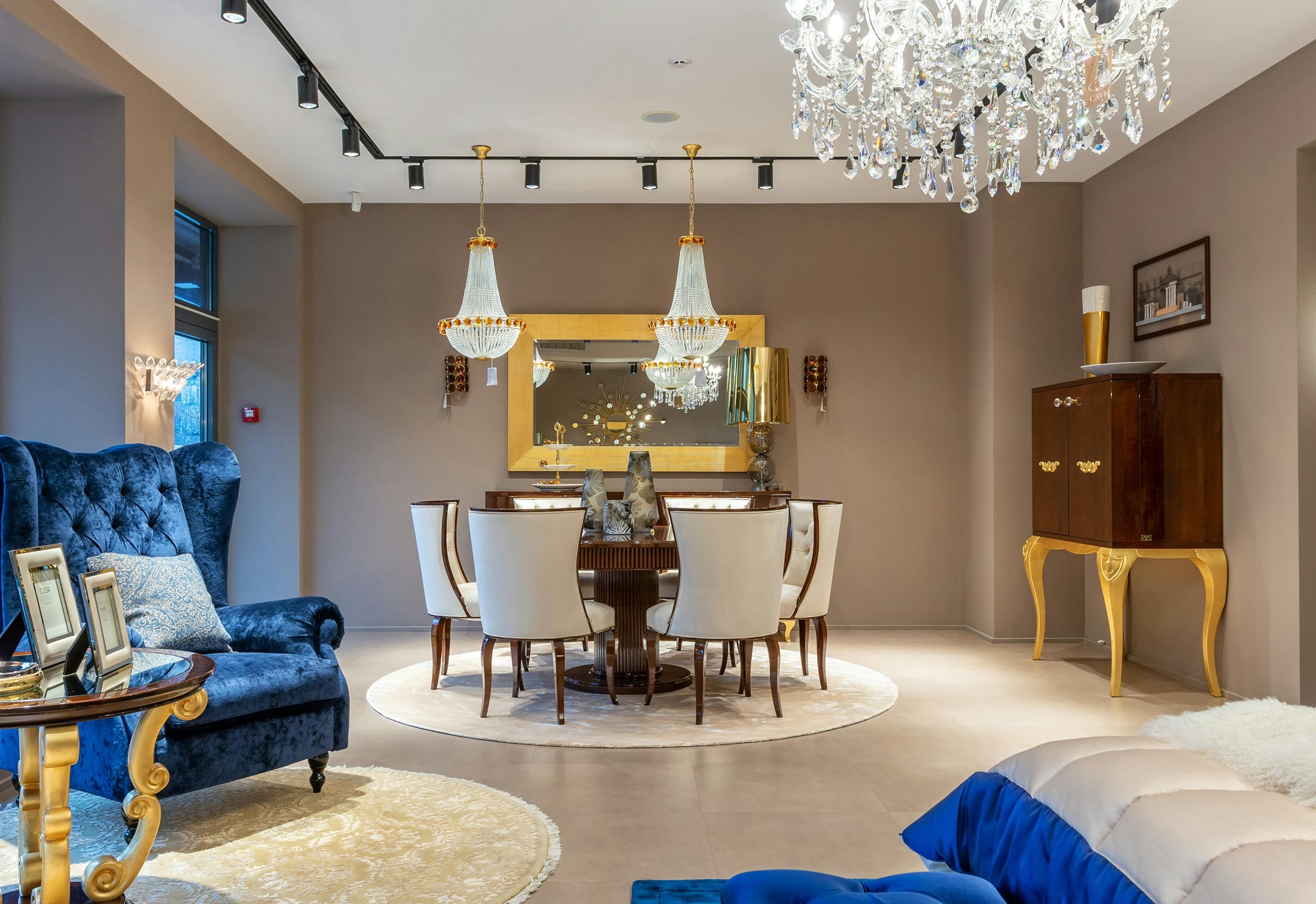
Born from a longing for luxury and a need for beauty in the grey post-war reality, Art Deco style continues to delight with its orderliness, symmetry and attention to detail. A living room decorated in this style guarantees an elegant, sophisticated and timeless interior that will enchant you from the moment you step through the door. In our guide, you’ll learn how to create a versatile base from the door to the wall colour, how to choose furniture, and how to combine luxury with modernity. We hope you enjoy the read!
Contents:
- An Art Deco living room – combining luxury with modernity
- Living room doors – durability and detail
- Wall colours – choose the backdrop for luxury
- Furniture and accessories with character
An Art Deco living room – combining luxury with modernity
If you dream of an interior that exudes elegance but does not overwhelm with a museum or palace glitz, you should definitely opt for an Art Deco living room, where modern functionality meets the glamour of the 1920s and 1930s. A well thought-out design in this spirit is an option for the bold, who love symmetry, fine materials and details with soul.
At the heart of this philosophy of interior design lies a longing for beauty and luxury. The interior celebrates technological progress, geometric forms and craftsmanship of the highest quality. Unlike the popular, minimalist Scandinavian style, the saying that “less is more” does not apply here. However, a rigorous approach to form is essential. The focus is on the organisation of space, symmetry and great attention to detail.
An interior decorated in this style must feature bold geometric forms inspired by the Cubists as well as decorative elements. Art Deco adores all glossy surfaces – gold-plated, chrome-plated, copper, stainless steel, nickel-plated as well as polishes and plastics. It is this shine that gives the space a luxurious and unique character. Fine upholstery fabrics for sofas, armchairs and chairs serve a similar purpose. Choose functional and perfectly crafted furniture, with beautiful, sophisticated designs that stand out thanks to the ornamentation – inlaid, carved or featuring tasteful, subtle gilding.
Living room doors – durability and detail
An Art Deco-style living room is an interior thought through down to the last detail. The foundation here is the interior door, which, when chosen appropriately, form a unique, sophisticated base for the design. The most desirable models will be those with straight lines, devoid of overly ornate grooves. Doors with millings that form symmetrical patterns or models with glazing arranged in geometric shapes characteristic of the 1920s will work well here.
An interesting design solution is doors with grooved glass, which create vertical stripes that beautifully diffuse the light. If privacy is a priority, doors with frosted glass are ideal, as they ensure privacy whilst allowing soft light from neighbouring rooms to enter the living room. Doors with flush mirrors also look striking. Mirror inserts will add depth and a touch of glamour to the interior.
When it comes to colour schemes, you can choose between classic solutions and bold ideas. Door leaves covered with a veneer imitating dark wood are the essence of this style. Models with a distinct grain, such as American walnut, mahogany or ebony, as well as exotic veneers, are perfect choices. If you wish to visually enlarge the space, opt for beige, off-white or the extremely fashionable cashmere doors. They will make the interior appear more spacious whilst retaining its luxurious character. For those who favour bold designs, doors in anthracite or deep black will be an absolute hit. Black, high-gloss lacquered doors will add incredible elegance to the living room and provide a great contrast to light-coloured walls.
Finally, the details, which are the true jewellery for the doors we have chosen. It is worth opting for finishes made of brass, chrome or gold-toned elements, paired with square escutcheons or handles with sharp, linear forms. We should also mention inlays, i.e. gold-coloured metal strips (so-called “muntins” inside the door leaf), giving the doors a modern, luxurious flair which are an interesting and very tasteful addition.
Wall colours – choose the backdrop for luxury
Are you wondering how to design an Art Deco living room? Properly chosen wall colour is just as important as the design base, i.e. the door and floor. It is the choice of paint that determines whether the interior will have a “boudoir-like” feel or will be rather modern and spacious. There are two possible stylistic approaches.
The first one is to use dark, deep colours, such as emerald green, deep navy blue or anthracite, which bring a touch of luxury and a hint of drama to the interior. These colours provide the perfect backdrop for gold accessories and light-coloured furniture. Remember, however, that dark walls require excellent lighting and a large space so as not to overwhelm the interior.
The other, safer, yet equally stylish choice is beige, ivory and powder pink. In order to add a touch of character to the living room, consider decorating one wall with geometric patterned wallpaper – ideally with gold or copper embossing. When it comes to Art Deco interiors, fan or scale motifs are absolute classics. Grey, dove blue and pastel blue also suit interiors decorated in this style. It’s worth complementing light colours with dark tones to add variety to the space and give it a unique flair.
Furniture and accessories with character
Furniture inspired by the style of “The Great Gatsby” is characterised by geometric, regular forms, glossy surfaces and bold colours. Every piece of furniture in this style is a unique, small work of art. Furniture is not purchased as sets, but each piece is selected individually.
A shell-shaped sofa with rounded edges has become a true must-have. The upholstery is made exclusively from velvet, which is soft to the touch and beautifully reflects light. Popular colours include bottle green, burgundy and mustard.
When it comes to coffee tables and chests of drawers, look for furniture with polished surfaces. Art Deco-style chests of drawers often take the form of a pyramid or rest on delicate, chrome-plated legs. A coffee table should have a top made of black or white marble or tempered glass. What else should you look out for when choosing Art Deco-style living room furniture?
| Key features | Description |
| Symmetry | The even distribution of decorative elements and patterns on fabrics has become one of the most important features of this style. |
| Geometric shapes | There’s plenty of scope for creative expression here. Feel free to use rectangles and sharp edges but also circles and ovals. |
| Vibrant colours | Vibrant colours are the essence of the style. Choose emerald green, navy blue, burgundy, purple and black, which are often paired with gold and silver embellishments. |
| Shiny elements | Opt for light-reflecting details in gold, silver, chrome, or those made of metal or glass. |
| Shiny textiles | A love of shiny surfaces is also reflected in textiles. Velvet and satin embrace this aesthetic. The upholstery of Art Deco sofas and armchairs is made of fabrics that are pleasant to the touch and subtly reflect light. |
| Luxurious materials | In their most luxurious form, Art Deco furniture features elements made of light or dark marble. |
Designing an Art Deco living room is a process of looking for a balance between historical glamour and modern comfort. The key to a successful interior design is quality, not quantity. By choosing dark, lacquered doors, a velvet sofa and geometric wallpaper, we can create a space that will delight every guest and make us feel as though we are at an exclusive party in our own home.