
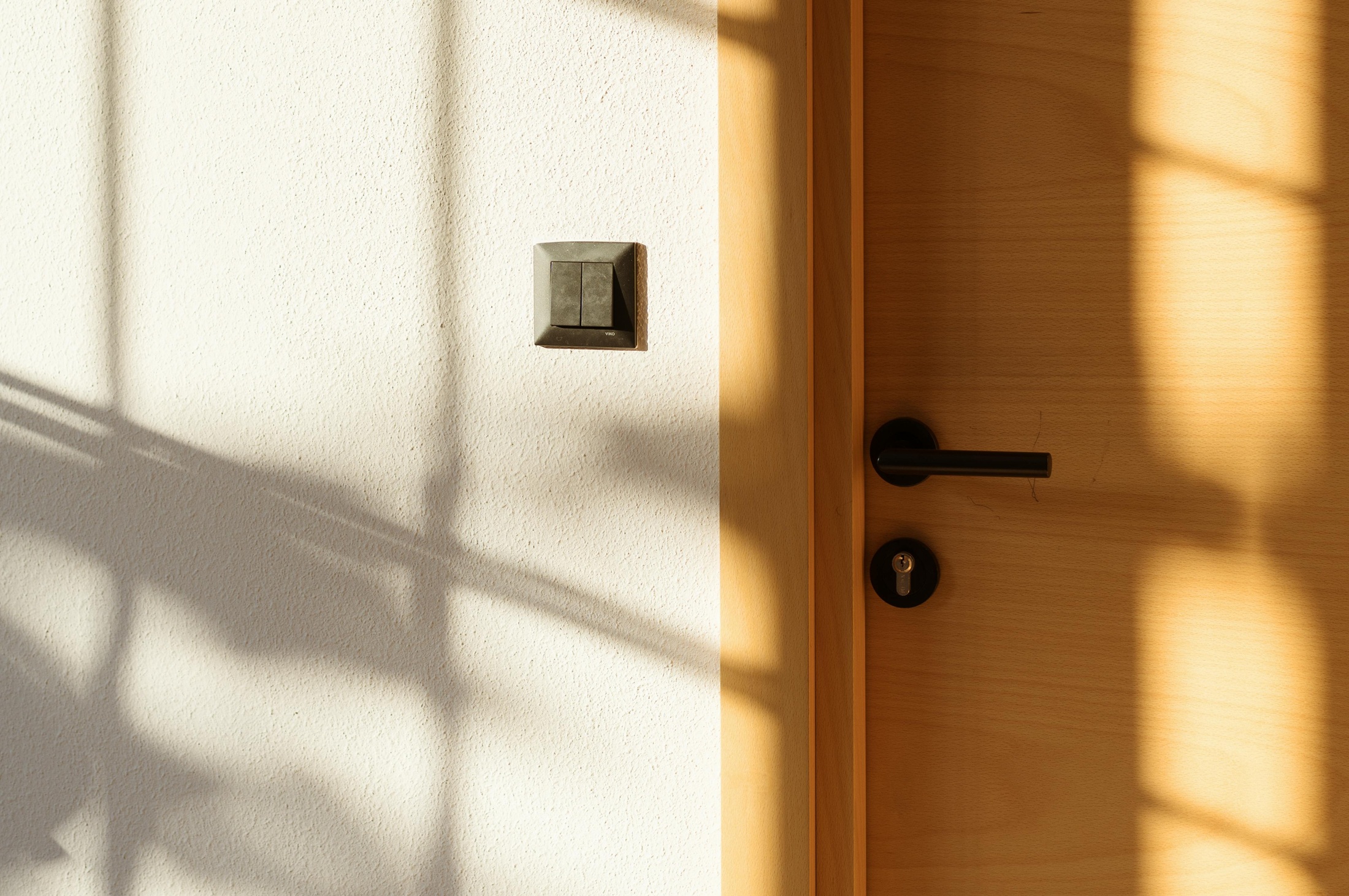
The standard height for a door handle is 105 cm above the finished floor level. This measurement is based on the average height of an adult and allows for a comfortable grip. Although 105 cm is an ergonomic standard suitable for most people, it is worth adjusting this dimension to the individual needs of household members, while maintaining consistent handle heights for all doors within the same room.
Choosing interior doors is one of those decisions made during the finishing of an apartment that we make once and live with for many years. We tend to focus on the colour of the finish, the type of glazing, and the direction in which the door opens. However, the devil is in the details we rarely think about, yet which have a significant impact on our everyday comfort. One such detail is the height at which the door handle is installed. Is there one universal handle height? Why isn’t the standard always ideal? And what should you do when people of very different heights live in the same household? Welcome to this comprehensive guide, which will answer all your questions.
Contents:
- Standards versus reality
- Why does the door handle height matter?
- Customisation – when to deviate from the norm?
- How to determine the optimal door handle height yourself?
- How to choose the right door handle?
Standards versus reality
Many people, even at the planning stage of a renovation, wonder not only which doors to choose, but also at what height the handle should be installed. Most door manufacturers in Poland and Europe adhere to a standard which stipulates that the handle should be positioned at a height of 105 cm from the finished floor level. Where does this figure come from? It is based on the ergonomics of the average adult height, allowing for a comfortable grip on the handle without excessive bending of the elbow or raising the arm.
However, it is worth paying attention to the term finished floor. This is the most common mistake, which occurs even at the door-purchasing planning stage. If we measure door openings and handle height at the screed pouring stage, we must add the thickness of the flooring, boards or tiles, along with the underlay or adhesive. This 1.5 – 2 cm difference can ultimately result in the door handle being too low, which will be noticeable every time you enter the room and will negatively affect the comfort of everyday use.
When choosing door joinery and deciding on the height for the handles, remember to be consistent and coherent. These are two key design principles that will influence the final impression of the interior and its functionality. Regardless of the height chosen, it must be identical for all doors within sight (e.g. in a single hallway). Even a 1 cm difference between the bathroom door handle and the bedroom door handle will be noticeable and create an impression of chaos and poor workmanship.
Why does the door handle height matter?
It may seem that 5 centimetres up or down makes no difference. Nothing could be further from the truth. Our body has what is known as muscle memory. If the handle is fitted too high, your shoulder joint will tire more quickly, the opening movement will not feel natural, and shorter household members will have to reach for the handle. On the other hand, a handle fitted too low forces the body to bend forward, which, with heavier door leaves, can put strain on the lumbar spine.
Besides practicality, aesthetic considerations are equally important. A poorly chosen handle height which disrupts the visual proportions of the door leaf can ruin a carefully crafted design effect.
Customisation – when to deviate from the norm?
When considering the ideal height for a door handle, 105 cm is generally regarded as a safe standard, but there are situations where a tailored approach is worth considering.
One such exception is the presence of particularly tall household members. If all residents are over 190 cm tall, a standard handle may seem unnaturally low. In custom-built homes, this height is often raised to 110 or even 115 cm to match the natural position of the hand with the elbow slightly bent. We also accept deviations from the standard in the case of people with disabilities. For wheelchair users, the optimal handle height is usually lower than the standard 105 cm. Installation at a height of 80–90 cm is recommended. This allows for easy access and the use of sufficient force to operate the mechanism without having to stretch the arm upwards excessively. Doors to children’s rooms are also a special case. Although it is rare to install handles lower down just for children, as they grow quickly, it is worth considering handles with an ergonomic, rounded shape, which are easier for a small hand to grip, even if it is positioned slightly above the child’s eye level.
When considering the height for a door handle, it is also worth taking into account the type of handle, which directly affects the perception of height. When choosing a door, we have the option of a door leaf with a handle on a long escutcheon, where the pivot point of the handle is clearly marked. Handles on a short escutcheon, which offer greater visual freedom, as well as pull handles common in sliding and external doors. Here, the installation height is more flexible, but the centre of the handle usually is at around the aforementioned 105 cm.
How to determine the optimal door handle height yourself?
When deciding to install a door handle at a non-standard height, it is worth knowing how to determine the optimal height yourself. In order to do it, you can perform a simple test. Stand naturally in front of a wall, bend your arm at the elbow to an angle slightly greater than 90 degrees (your hand should be pointing slightly downwards), mark the spot on the wall where your hand naturally rests, and then measure the distance from the floor. This height is considered to be the most comfortable.
How to choose the right door handle?
Choosing a door handle is often the final stage of a renovation, but it is this detail that determines the final character of the interior. How to choose the right door handle so that it not only matches the style of the door but also the interior?
Firstly, match the style of the handle to the design of the door leaf. For modern doors with clean lines, minimalist models with geometric shapes (square or rectangular rosettes) are the perfect match. On the other hand, classic doors with milling will look good with rounded shapes, patina or brass.
Secondly, remember to maintain colour consistency. The door handle should complement other details in the room – furniture fittings, lamps or wardrobe handles. Currently, matt black door handles are all the rage, adding a touch of edge, as is brushed gold, which brings elegance without unnecessary sumptuousness.
Thirdly, ergonomics, which is of key importance. The door handle must fit comfortably in the hand. Before purchasing the entire set, it is worth checking that the edges are not too sharp and that the mechanism operates smoothly and quietly. Let’s also remember to choose the right escutcheon: full, key-operated, with a mortise lock or a bathroom lock. A well-chosen door handle is an investment in the comfort of everyday use. Below, we present a few tried-and-tested models that suit the most popular interior design styles.
| Design style | Type of handle |
| Modern | Modern interiors are dominated by simple, geometric forms and minimalism. Door handles in chrome, silver and deep black work best. Handles with square escutcheons with sharp edges or futuristic, ergonomic shapes are also popular. High-gloss chrome models perfectly emphasise the sterile, minimalist character of a modern room. |
| Classic | Classic is synonymous with timeless elegance, harmony and symmetry. Here, door handles in shades of brass, old gold, patina or antique silver will be ideal. Choose models with smooth, rounded shapes and subtle embellishments. Door handles on a long backplate are also a popular choice, adding a touch of sophistication and traditional elegance to the door. |
| Industrial | This style emphasises the raw quality of materials such as concrete, metal and wood. Matt black door handles are an absolute hit in interior design, creating a striking contrast with light-coloured walls or exposed brick. Be sure to choose solid, sturdy designs with a technological look. In loft-style doors (glass in metal frames), minimalist pull handles are often used instead of traditional door handles. |
| Scandinavian | This style is based on light colours, functionality and a closeness to nature. Designers recommend door handles in muted colours: white, light greys, brushed steel or nickel. Satin finishes are also popular due to their practicality, as they do not show fingerprints. The Scandinavian style is dominated by slim, visually light door handles with gentle lines. Interesting combinations of metal with wooden elements are also common, which add warmth to the interior. |
The ideal handle height is one that allows the door to be opened intuitively, effortlessly and without having to think about the movement of the hand. The standard 105 cm will work in most cases, but it is always worth comparing this standard with your own needs and the height of the household members. If in doubt, it is worth consulting the installation team before fitting to ensure that the height is measured from the final floor level.