
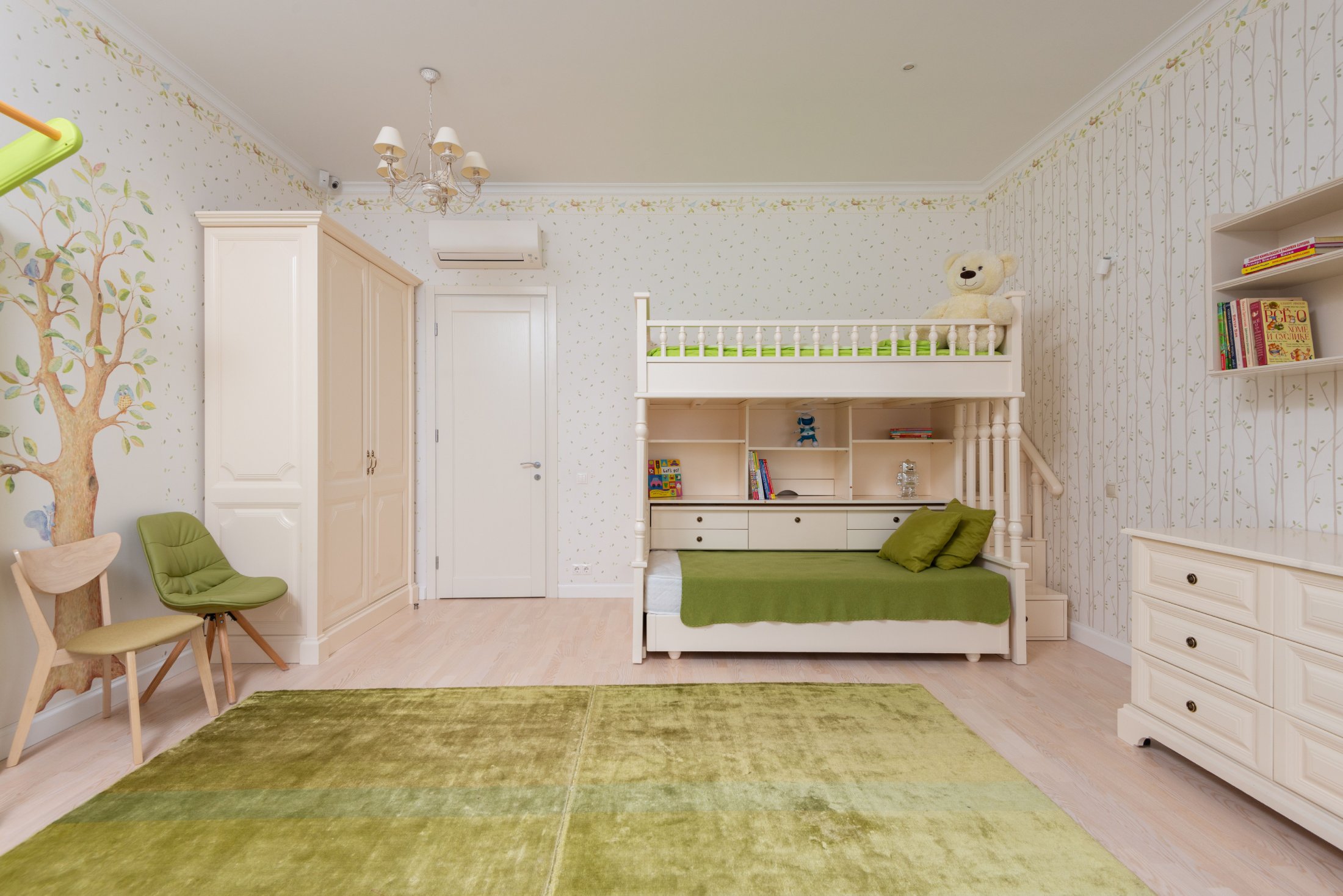
When designing a child’s room, it is worth dividing it into dedicated sleeping, playing, and learning zones, while ensuring safety by choosing furniture with rounded edges and secure fixings. It is also important to choose sound-insulating doors with a damage-resistant laminate finish and safety glazing. A neutral color palette makes a great foundation, while the interior can be personalized with accessories that are easy to replace as your child grows.
Designing a child’s room is one of the most demanding interior design challenges. The space needs to serve several purposes at once: it should be a safe haven, a creative playground, an ergonomic place for learning, and a peaceful oasis for sleep. Parents often focus on choosing the crib or bed, wall colors, or toys, while overlooking an element that ties the entire room together and plays an important role in providing privacy and quiet — the interior door. Wondering how to create a space that “grows” with your child? Not sure what to look for when purchasing a door leaf? Our specialists have prepared a practical step-by-step guide to help you design the perfect kingdom for your little one.
Contents:
- Zoning is the key to functionality
- Safety first
- Which doors to choose for a child’s room?
- Glazed doors – are they safe?
- Smart accessories and details
- Opt for timeless aesthetics
Zoning is the key to functionality
Many parents wonder how to design their child’s room so that it is a practical, safe and attractive space, ideal for unrestricted play and children’s creativity. Before ordering the first piece of furniture, it is worth planning the layout carefully. A well-designed children’s room should be divided into three distinct zones. The first is the rest and sleep area, with a comfortable bed as its focal point. It should be positioned away from any direct draughts (e.g. windows) and away from the door, so that a parent entering the room is less likely to disturb a sleeping child. For this part of the room, it’s worth choosing muted colours and light-blocking textiles.
The second zone is a space for play and creativity. This is where a soft rug, a low table for craft activities and easily accessible toy shelves will find their place. The key is to make it easy for the child to tidy up the space on their own – labelled or picture-marked storage containers will be really helpful.
For slightly older children, it’s also essential to set up a study area. A desk with an ergonomic chair will be essential here. Proper lighting is equally important – natural light should come from the left for a right-handed child or from the right for a left-handed one.
Safety first
Not sure how to furnish a child’s room to make it safe? When designing the room, it’s worth looking at the world from the perspective of a young explorer. Every piece of furniture must pass a safety test. Choose furniture with rounded edges. Heavy bookcases and chests of drawers must be securely fixed to the wall – children love to treat shelves as climbing frames.
Paint the walls with certified hypoallergenic paints (e.g. certified by the Polish Society of Allergology). Choose washable products – in the realm of a child’s imagination, the wall often becomes an artist’s canvas. Avoid free-standing floor lamps, which can easily be knocked over during boisterous play. Instead, opt for safe wall-mounted sconces and bedside lamps powered by batteries or low voltage.
What doors to choose for a child’s room?
Choosing doors for a child’s room is a long-term investment. The doors must withstand being hit by a ball, repeated slamming, and sometimes even artistic endeavours involving paint or crayons. When buying models from leading manufacturers, such as Classen, you should take four key parameters into account.
Firstly, the construction and resistance to damage. It’s a bad idea to buy the cheapest doors with honeycomb filling. They’re lightweight but prone to dents. For a child’s room, doors with a core made of perforated chipboard or MDF are the best choice. They’re considerably heavier, but this makes them more stable and resistant to impact and slamming. The external finish is equally important. The best choice is doors covered with CPL or HPL laminates, which offer enhanced scratch resistance and are easy to clean. This means that fingerprints, modelling clay or crayon marks can be wiped away with a damp cloth without risking damage to the surface.
Young children need a nap during the day, whilst older children need peace and quiet whilst doing their homework. In the evening, parents want to be able to chat freely or watch television in the living room. When choosing doors, pay attention to the sound reduction index (Rw). The higher the value, expressed in decibels (dB), the better the sound insulation. Rebated door leaves with perimeter seals will ensure good noise reduction.
Glazed doors – are they safe?
This is a perennial dilemma for parents. On the one hand, solid doors guarantee maximum soundproofing and privacy. On the other, delicate glazing allows parents to discreetly check whether their little one is asleep, without having to open the door and cause it to creak. The light filtering in from the hallway also helps children who are afraid of the dark. If you decide to go for a glazed door, choose only models with safety glass (toughened or laminated VSG). In the event of a strong impact, toughened glass shatters into small, blunt pieces, whilst laminated glass cracks but its fragments remain bonded to the film, eliminating the risk of cuts. Before making a decision, it is worth weighing up all the pros and cons of this solution. Our specialists have put together a comparison to help you choose the perfect model.
| Feature | Solid doors | Glazed doors |
| Sound insulation | Very high – ideal for noisy homes | Average – depends on the size of the glazing |
| Parental control | Requires the door to be opened | Ability to peek through the glass |
| Fear of the dark | Complete darkness (requires a lamp) | Allow gentle light from the corridor to pass through |
| Dirt-resistant | Easy cleaning of the entire surface | The glass panels require more frequent wiping to remove fingerprints |
Smart accessories and details
Small details also play an important role in ensuring both the safety of a child’s room and its day-to-day functionality. When it comes to internal doors, you can enhance their functionality with small but crucial additions. First and foremost, soft-close systems and magnetic locks, which prevent loud slamming. Locks and limiters, which protect little fingers from getting trapped. If you’re designing an older child’s room and are considering buying a door with a lock, choose one with a bathroom lock. This option will prevent your child from accidentally locking themselves inside the room, and if necessary, it allows the door to be unlocked easily from the outside using a coin or a similar flat object.
Opt for timeless aesthetics
Children’s tastes change in the blink of an eye. A room themed around a specific cartoon will delight a five-year-old, but for an eight-year-old it will be a source of embarrassment. How can you avoid this? Opt for a timeless design base. Floors, doors and walls should be neutral. Opt for doors in white, light grey or natural wood tones. This choice is a design chameleon – these versatile colours will adapt effortlessly as the room evolves from a baby’s corner to a teenager’s room. Create a fairy-tale atmosphere with easily interchangeable accessories such as wall stickers, cushions, rugs, posters or bed linen.
A great way to personalise the doors is with special magnetic mats or reusable stickers, which can transform a door leaf into a castle gate or a chalkboard in a matter of moments, without damaging the finish. Avoid intense and vibrant colours, as they can make it harder for children to relax and concentrate. If you’re dreaming of a bold colour accent or a striking pattern, opt for accessories or cover one of the walls with an interesting wallpaper.
Designing the perfect child’s room is an art of striking a right balance between aesthetics and functionality. By choosing safe furniture, ensuring the room is zoned effectively, and investing in sturdy, soundproofed internal doors, you’ll create a space where your child can spread their wings in safe and comfortable surroundings. Remember that the devil is in the details – the quality of the construction materials directly translates into safety, peace of mind and trouble-free use for many years to come.