
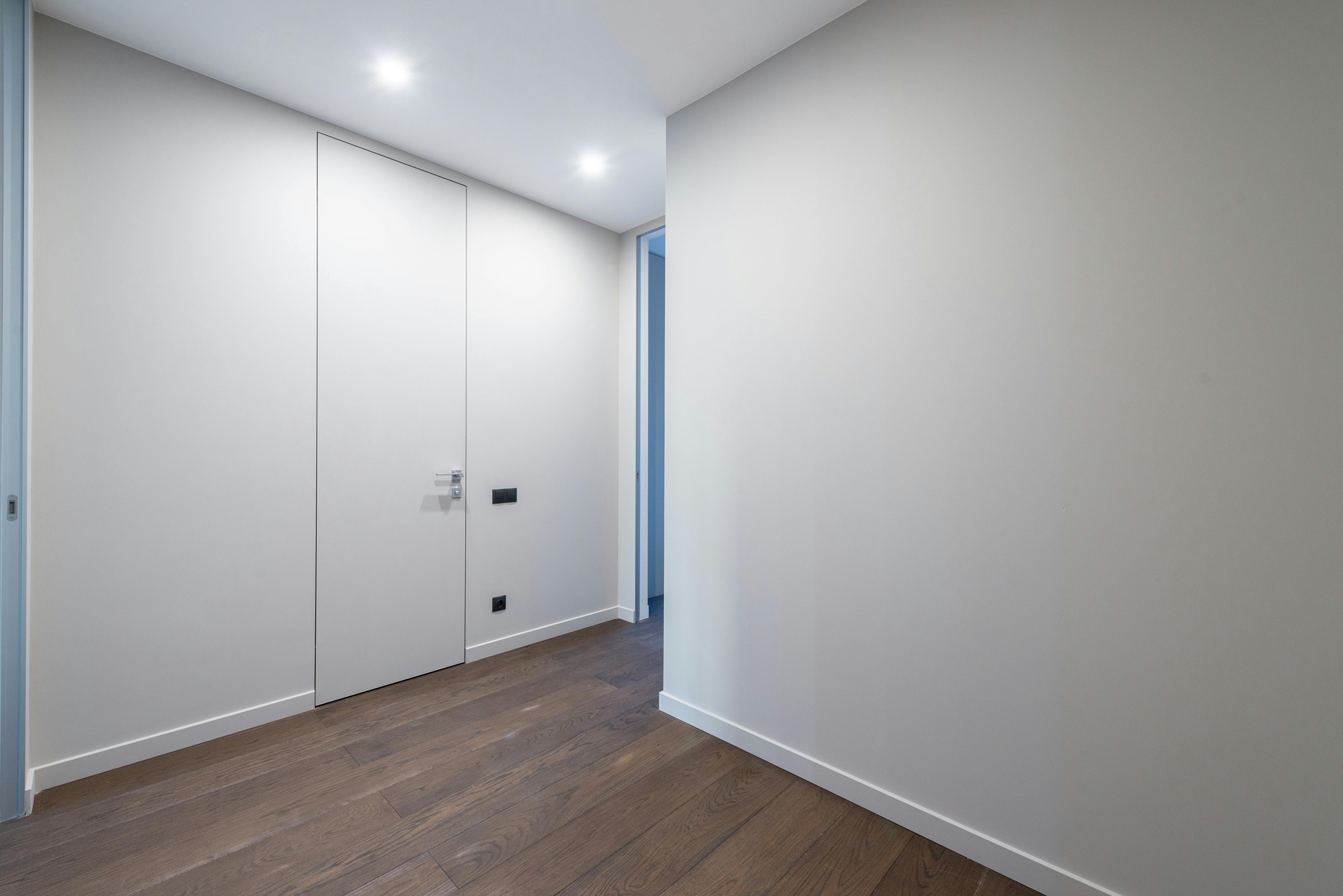
Minimalist, functional and extremely aesthetic – non-rebated doors are becoming increasingly popular. We eagerly choose them when decorating interiors not only in a modern, but also in Scandinavian, classic or industrial style.
In order for them to serve us in perfect condition for many years, we must take proper care of them and adjust them periodically. In our article, we will advise you on what to do to prevent the door leaf from rubbing against the floor or frame, as well as what to do when the door starts to squeak. How to adjust non-rebated doors? Let us give you some hints!
Contents:
- Non-rebated doors – a hit in contemporary interior design
- How to care for non-rebated doors?
- The most common problems with non-rebated doors
- How to adjust non-rebated doors – step-by-step guide
Non-rebated doors – a hit in contemporary interior design
Non-rebated doors became a hot topic a few years ago, when they took the interiors of houses and flats by storm. Their unwavering popularity stems from their unique, modern and minimalist design, functionality and exceptional elegance. What is the secret of this model? Non-rebated doors are distinguished by the absence of visible hinges and a rebate, the element of the door leaf that overlaps the door frame. This solution is found in classic models.
When closed, non-rebated doors form a uniform, smooth surface with the door frame, giving them a unique, elegant and minimalist look. Doors of this type are equipped with special 3D hinges, which strongly emphasise their modern character. This advanced solution allows for quiet and trouble-free closing of the door without the need to press the handle.
The enormous popularity of non-rebated doors also stems from their simplicity, which fits perfectly into many fashionable interior design styles, such as modern, minimalist, loft, industrial, as well as Scandinavian or boho. Wherever moderation, simplicity and understated elegance are of key importance in an interior, non-rebated doors will excel.
Choosing this type of door is also an ideal solution for all small spaces that need to be visually enlarged. Simple doors with a uniform surface introduce lightness, spaciousness and subtlety to the interior design, which harmonises perfectly with the surroundings. The uniform surface of the door makes it easy to keep clean, which enhances the impression of neatness.
The most common problems with non-rebated doors
As with any doors, including non-rebated ones, problems may arise due to incorrect installation and subsequent intensive use. The most common issues include the door leaf rubbing against the floor or door frame, the door sagging or warping, failure to close properly, squeaking hinges as well as unevenness and gaps between the door and the wall. Each of these problems can be fixed by adjusting the non-rebated door correctly.
However, in order to do it, we need to identify the source of the problem and carry out the repair properly. This will prevent further damage and improve the comfort of everyday use. The entire process can be easily carried out by ourselves using the detailed guide presented below. However, we should remember that in case of any doubts or questions, it is worth consulting a specialist or the manufacturer. Incorrectly performed door adjustment and resulting damage may lead to the loss of warranty and the need to replace individual door leaf components.
How to adjust non-rebated doors – step-by-step guide
Before adjusting non-rebated doors, prepare all the necessary tools. You will need Allen keys (or hex keys) in sizes 3, 4, and 5 mm, a Phillips or flat-head screwdriver to help you remove the covers, a spirit level to check the horizontal and vertical alignment, a pencil with a tape measure to mark the adjustment points as well as silicone grease to lubricate the hinges. Preparing the tools in advance will make the work easier, allow for precise adjustment of the door leaf, and help avoid downtime.
First of all, it is worth mentioning that when adjusting non-rebated doors, the most important element are the hidden 3D hinges concealed under plastic covers, which must be removed. Four holes with screws will be then visible, and by tightening or loosening them, we can adjust the door in three planes. It is possible to adjust the height, seal pressure and side clearance. Depending on the hinge model, the manufacturer determines the method of adjusting the hinges.
It is worth knowing that the first screw located in the centre of the door frame is used to adjust the door overlap. The screw must not be tightened completely; it is necessary to leave a clearance of approx. 0.5 mm. The second screw is used for vertical adjustment, which allows the door leaf to be raised and lowered relative to the floor. It is possible to compensate for differences in the range of 3-4 mm. Adjusting non-rebated doors yourself is not difficult if performed according to the instructions below.
| Step | Description |
| 1. Checking the contact points | Work on adjusting non-rebated doors should begin by observing where the door leaf rubs. Mark the problematic area with tape or a pencil in the least visible place. |
| 2. Removing the covers | To remove the hinge covers, simply pry them off gently with a screwdriver. |
| 3. Tightening or loosening screws | Depending on the problem, hinges can be adjusted in three planes: up and down, side to side, and front to back. To do this, use an Allen key of the appropriate size. |
| 4. Height adjustment | If the door leaf rubs against the floor, raise it by adjusting the hinge at the bottom of the door. |
| 5. Aligning the gaps | If gaps appear, carefully check the position of the door leaf and adjust the side hinges. |
| 6. Lubricating the hinges | Technical silicone or special door lubricant is the ideal remedy for squeaky doors. Apply a small amount of the substance, thoroughly wiping the area around the hinges. |
| 7. Checking the results | The final step is to carefully close and open the door several times to check the final result of the adjustment. If something still does not work properly, repeat the adjustment. |
When adjusting non-rebated doors, precision is of utmost importance. Very small adjustments are enough to achieve a noticeable improvement. Long-term trouble-free use of non-rebated doors is possible provided that we prevent potential problems rather than wait for them to arise. Pay attention to all changes in the door’s operation, even minor ones. The first signs of squeaking or rubbing are the best time to take action.
To enjoy trouble-free operation of non-rebated doors, simply follow a few rules, which include regularly checking the hinges and lubricating them twice a year – especially in summer and winter – and avoiding closing the doors too forcefully, which can cause the hinges to become misaligned.