
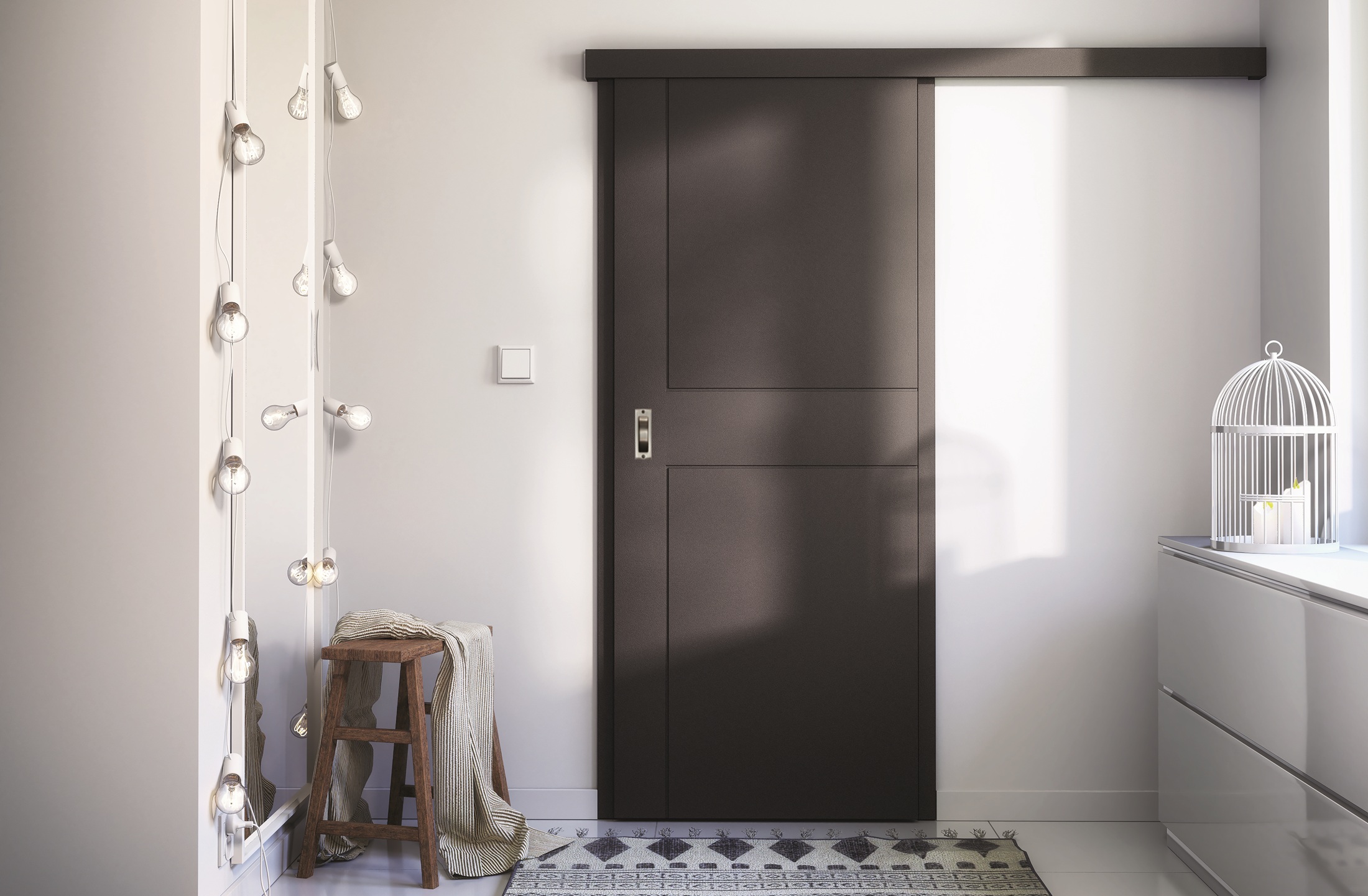
A small flat, an incommodious room or an unusual design vision often requires an unconventional approach. Hence the enormous popularity of sliding doors, which are ideal wherever traditional solutions fail. Installing them guarantees aesthetic and practical qualities, but does it also provide adequate acoustic or thermal insulation? Are there ways to seal sliding doors? Let’s find out!
Contents:
- Types of sliding doors
- What does the airtightness of sliding door leaf depend on?
- How to seal sliding doors?
- Beautiful and aesthetically pleasing – the most fashionable sliding door models
Types of sliding doors
Just like traditional doors, sliding doors are also divided into several types. The most common division is based on the type of sliding system used. The most popular model is an on-wall sliding door, which is mounted on a special track using running systems. This solution is characterised by extremely simple and trouble-free installation without the need for extensive renovation. It is also the most budget-friendly option if you opt for a simple, minimalist leaf and rail in the basic version.
A wall-mounted door works well where space is really tight and mounting a hinged door would interfere with passageways or would simply be impossible to open. The second type is a sliding door that slides into a specially designed pocket in the wall. Although this type of door requires considerably more effort and additional construction work, it is definitely worthwhile. It’s best to plan the installation of this type of door already at an early stage of construction or renovation work. This solution works well in very small flats, where every extra centimetre is worth its weight in gold.
A pocket door is an extremely interesting and functional idea for separating two spaces – the kitchen from the dining room or the living room, or the bedroom from the walk-in closet. The unique design of this type of door gives the space a minimalist and modern look. On the market we can still find so well-known to everybody accordion doors, which, although definitely less durable and visually outdated, still fulfil their function of separating rooms.
What does the airtightness of a sliding door leaf depend on?
The airtightness of a sliding door leaf depends on several factors. The most important will be the type of sliding system mentioned above. A door mounted on the wall on a special rail is unable to provide us with either adequate thermal or acoustic insulation due to the distance from the wall.
The only model that is able to guarantee optimal airtightness is a door sliding into a pocket inside the wall. If we decide to install this model, it is worth paying attention to the type of seal between the door frame and the door leaf. Only good quality, well-fitting gaskets will provide adequate acoustic comfort. The sealing can be made of silicone profiles, bubble or rubber gaskets.
Another important matter is the type of material used for the sliding door. In this case, the robustness of the door material does not always translate into airtightness. It is not uncommon for wooden models, which are very sensitive to changes in temperature or humidity, to become warped or deformed, which has a direct impact on their airtightness. Doors made of PVC or aluminium often have gaskets, which provide better thermal and acoustic comfort.
Another important factor is the thickness of the door leaf – as a rule of thumb, the thicker the door, the better the insulation parameters, i.e. the ability to dampen sounds coming from outside. If you are looking for sliding doors for a home office where you want to enjoy quiet and comfortable work, it is essential to choose robust, heavier models. Thin and lightweight doors will not be able to provide us with adequate soundproofing. When it comes to the airtightness of a door, correct installation also plays a key role. Poorly performed installation can result in gaps between the door frame and door leaf, negatively impacting the interior’s acoustic and thermal insulation. It is advisable to have this task carried out by a professional team or read the installation instructions very carefully if you want to do it yourself.
How to seal sliding doors?
The airtightness of sliding doors can easily be improved by applying a few tried and tested methods yourself. Self-adhesive gaskets, sealing tapes or brush seals are available on the market to deal with small gaps. For larger gaps, it is worth using silicone or polyurethane foams. It is important to choose the right material for the size of the gap and the material of the sliding door.
Remember to check the condition of the seals periodically and replace them if they are no longer effective. Take care to regularly check the running system to ensure that the door leaf fits perfectly into the door frame. Sometimes problems with airtightness occur not because of a defective gasket, but because of a malfunctioning running system.
Are you wondering how to seal a sliding door yourself? It’s simple – here’s a step-by-step guide to sealing your sliding door leaf yourself.
| What to do? | Instructions |
| Check the condition of the gaskets | When working on sealing a sliding door, it is a good idea to start by checking the condition of the existing gaskets. Any damaged, peeling or cracked ones should be replaced immediately. |
| Choose the sealing material | Make sure to select the right sealant for the type and model of your sliding door. Use easy-to-install and widely available self-adhesive gaskets, which offer a perfect fit in terms of size and shape. It is a good idea to choose sealing tapes or brush seals for additional protection against insects and dust. For larger gaps, use polyurethane foam or silicone to protect the edges and the contact points between different materials. |
| Prepare the surface properly | Before installing the gasket or tape, be sure to clean and dry the area where you will be applying the chosen material. A poorly cleaned, dusty or greasy area will prevent the adhesive from sticking properly to the door or frame. |
| Install the seal | Apply the tape or gasket onto the cleaned surface. Remember to remove the protective tape from it beforehand. Make sure it tightly adheres to the surface of the door leaf or frame over its entire surface. |
| Check the level of tightness | Finally, check that the door has been properly sealed and that there are no visible gaps anywhere. Close and open the door several times to ensure that the material does not rub against another surface and that nothing impedes the smooth operation of the door. |
Beautiful and aesthetically pleasing – the most fashionable sliding door models
Sliding doors are chosen not only for their practicality, but above all for their aesthetics, which will be in perfect harmony with the design style of the interior. One model will work well in a modern, minimalist room, while other will be perfect for a rustic or chalet-style interior.
Among the most popular models of sliding doors, we can find those covered with wood-like veneer, perfectly in line with the most fashionable trend in interior design based on a return to what is natural. Doors with a veneer imitating wood are an excellent choice for modern, boho, rustic, as well as Japandi interiors. A door in a solid white colour is a perfect choice for minimalist, modern and Scandinavian interiors. For loft or industrial interiors, go for black or anthracite-coloured doors. In the case of small interiors where we need to improve proportions and add lightness, models with a mirror flush with the door leaf surface will be ideal.