
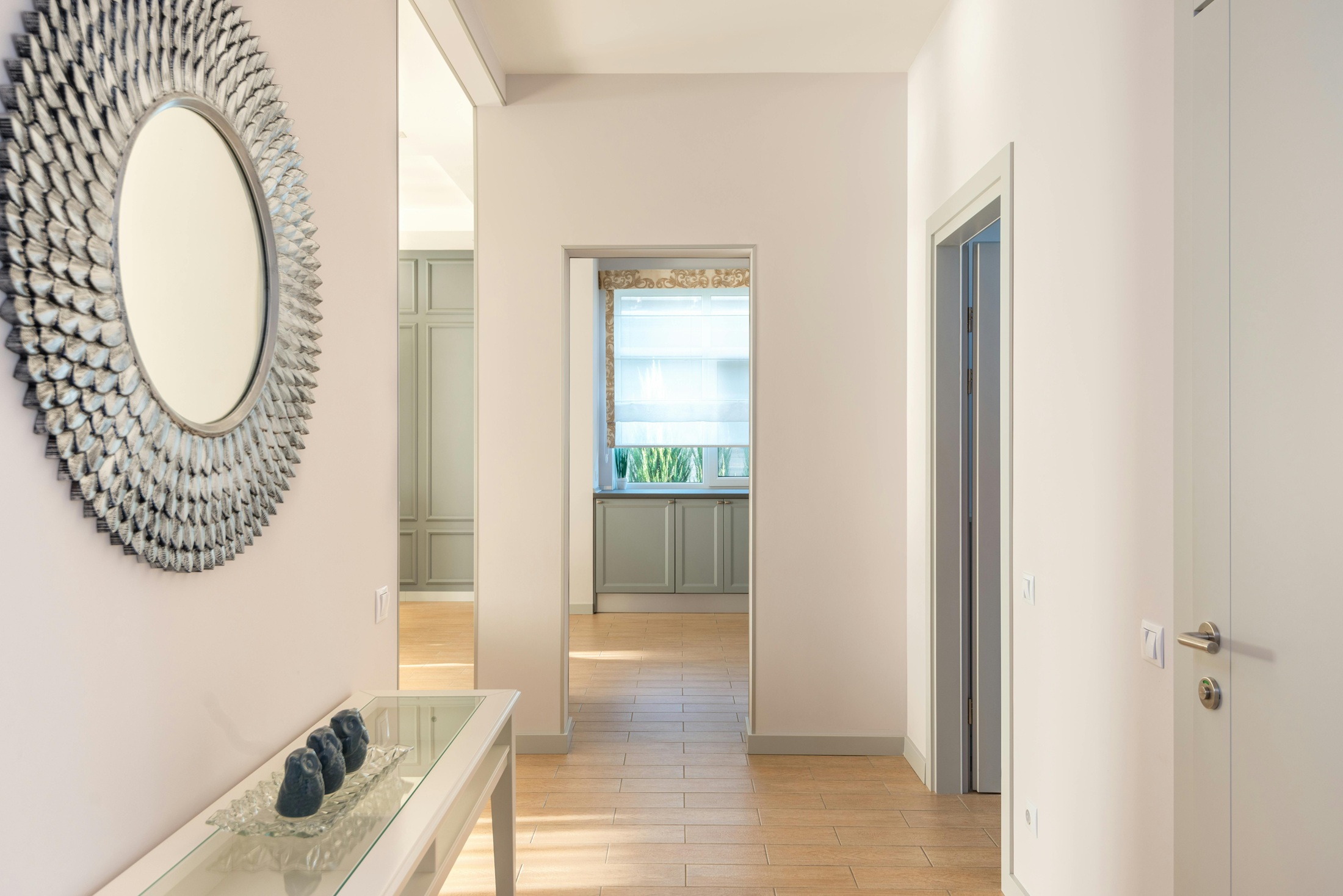
Modern house and flat designs are increasingly moving away from the classic, closed layout of rooms. Instead, we get larger and brighter interiors, where the hallway connects to the living room. Although impressive, this solution proves to be quite a challenge in terms of interior design.
Are you wondering how to separate the living room from the hallway so that the design is consistent, functional and aesthetically pleasing? In the following article, we present proven ways to separate the living room from the hallway. We hope you enjoy the read!
Contents:
- Advantages and disadvantages of a hallway connected to the living room
- How to separate the living room from the hallway? A few proven ideas
- Sliding doors – a clever solution for difficult spaces
- Divide and connect, or how to separate the living room from the hallway
Advantages and disadvantages of a hallway connected to the living room
An open-plan hallway leading to the living room is a solution that has gained popularity thanks to modern house designs and flats that are characterised by small floor area. A properly designed space guarantees functionality and an extremely effective first impression. This type of layout has many advantages and disadvantages, and it is worth being aware of them before deciding to use such a solution in your own home.
The main advantage is spaciousness. The lack of division helps to enlarge the space, which is extremely important in the case of very small flats and studios, and also makes it easier to arrange the interior and move around. A hallway connected to the living room also increases the amount of daylight, which is usually lacking in a cramped and incommodious hallway. The disadvantages include visual chaos caused by the lack of stylistic consistency between the two areas, as well as limited privacy. Another particularly problematic issue is the transfer of dirt and the difficulty of keeping the space tidy. However, spacious wardrobes and closets, where we can hide seasonal clothing and shoes from view, may be helpful.
If the hallway is connected to a living room with an open-plan kitchen, cooking odours can be bothersome, as they will be noticeable as soon as we enter the house. In the case of poorly designed ventilation, intense aromas can penetrate clothes left in the hallway. The obvious disadvantages of this solution also include reduced thermal comfort during the colder periods of the year. While sitting on the sofa in the living room, we may feel an unpleasant chill when the external door is opened.
How to separate the living room from the hallway? A few proven ideas
Contrary to appearances, separating the living room from the hallway is not the easiest of tasks. It is not easy to arrange the space in a way that benefits both rooms, but it is worth undertaking this challenge. There are two ways to separate the space.
The first and simplest is a conventional but clear separation resulting from the use of different materials on the walls and floor. In the hallway, it is worth laying durable floor tiles or waterproof flooring. However, when choosing the floor covering, it is important to remember that the difference between the surfaces should not be too contrasting. Too much colour difference can make the space look smaller and create visual chaos. The same rule applies to walls. The division of zones should be subtle so that the interior is harmonious and consistent across the entire visible surface.
An excellent solution for separating these two spaces is to choose aesthetic furniture. A bookcase or cabinet can replace a partition wall. There are specially designed pieces of furniture of this type available on the market, which are ideally suited to serve multiple functions. On the one hand, they will help us hide unnecessary clothes while simultaneously serving as a cabinet in the living room. For smaller interiors, open bookcases are a good choice, as they discreetly divide the interior without restricting the flow of sunlight.
Sliding doors – a clever solution for difficult spaces
Are you wondering how to separate the living room from the hallway? Sliding doors are a stylistic bull’s eye! Extremely aesthetic and functional, they will help us divide the space freely at any time. There are two types of sliding doors available on the market. Standard ones mounted on the wall using special sliding systems, as well as models hidden in a special pocket inside the wall. Their installation requires special preparations, so it is worth considering it already at the construction stage or at the start of a major renovation.
Depending on the size of the interior, we can opt for single or double-leaf doors. This solution will make it easier for us to divide even a really large space. Sliding doors offer a whole host of benefits.
A huge selection of models will make it easier for us to match the interior design style we have chosen. In addition to classic white doors or those covered with wood-like veneer, we can opt for coloured doors. Cashmere shades or more pronounced colours such as sage, navy blue, burgundy, or anthracite will be a great choice. When it comes to the most fashionable colours, doors in the colour of the year, Mocha Mousse, which is an extremely successful variation on brown have become available. If we want a more subdued and safe arrangement, it is worth choosing sliding doors covered with wood-like veneer. Models in light, delicate shades will not overwhelm a cramped hallway and at the same time will introduce lightness and soothing warmth to the space.
Sliding doors take up little space, so they will easily fit into a small area without obstructing passageways or colliding with other elements of the interior design. Depending on your needs, you can close and open them to connect or separate the hallway from the living room.
Divide and connect, or how to separate the living room from the hallway
The interior design market offers us many proven, aesthetic and practical ways to separate two spaces. In the case of the living room and hallway, it is worth choosing solutions that will not visually reduce the size of the rooms and will not limit the amount of sunlight. We should definitely look for ideas that will not obstruct passageways and will not make it difficult to use both areas. What else can help us separate the living room from the hallway?
| Ideas for separating the living room from the hallway | Justification |
| Plasterboard wall | This is a definite and final solution, which is worth using in special cases during a general renovation. It will not work in small flats or studio flats. |
| Openwork wall | An openwork wall made of slats is an extremely popular way to aesthetically separate two spaces. Their light construction and elegant appearance will suit almost any interior design style. Other advantages include easy installation and a wide range of designs. It suits modern, loft, Scandinavian, industrial, retro and glamour styles. |
| Glass partition | A partition in the form of a glass pane is an option that will help to visually enlarge the space, let in a lot of light and guarantee a coherent composition. It blends perfectly with other popular interior finishing materials such as wood, metal, natural stone and concrete. However, it requires regular cleaning and may be off-putting due to its price. |
| Plants and screens | Screens and plants in large pots are probably one of the cheapest options for separating the hallway from the relaxation area. Large plants with lush leaves create a natural partition, additionally soothing the senses and purifying the air. |