
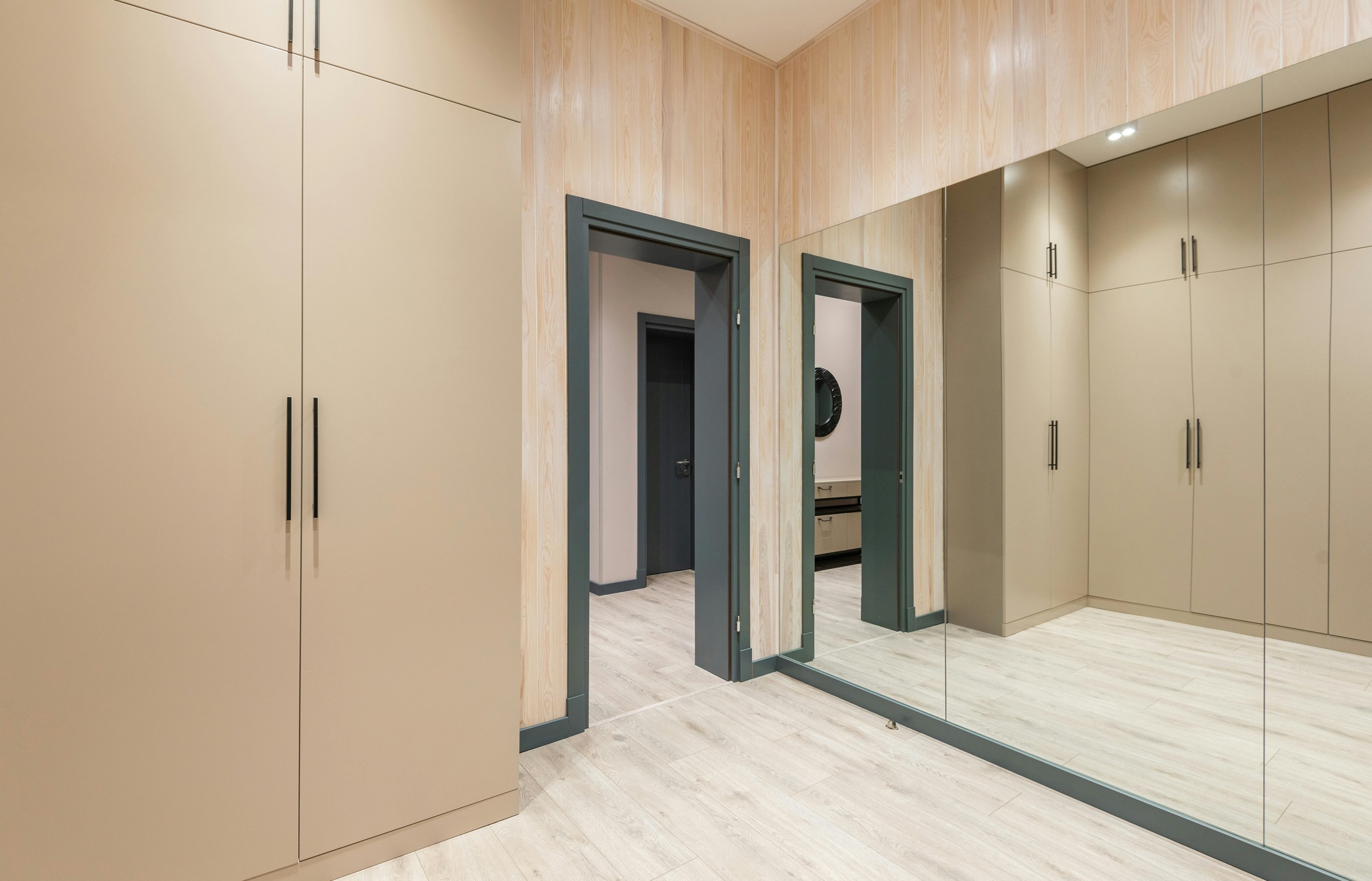
Anyone who has ever built, renovated, or decorated a house or flat has certainly encountered terms such as door casing, door jamb, and door frame. These names are often used interchangeably and are frequently confused, which can be misleading and cause uncertainty. Are you looking for an answer to the question of what a door casing and door jamb are and how they differ from a door frame? Our specialists have prepared a practical guide where they dispel all doubts and explain complex construction nuances in a clear and transparent manner. We hope you enjoy the read!
Contents:
- Door casing or door frame? Which name is correct?
- Door jamb or door frame – are they the same thing?
- What is a door frame?
- An overview of the most popular types of door frames
- Door frame – a stylish decoration for the most fashionable interiors
Door casing or door frame? Which name is correct?
Everyone has probably come across terms such as door casing and door frame at least once. They appear most often in the context of doors or windows. Many people use both words interchangeably, assuming that they mean exactly the same thing. Nothing could be further from the truth! A door casing is not the same as a door frame, and mixing up these two terms can cause a lot of confusion when renovating. Both names are correct and using them in the right meaning and context will make it much easier to navigate the maze of interior design nuances. So, what is the difference between a door casing and a door frame?
| Door casing | Door frame |
| A door casing is the finishing of the joint between the door frame and the wall. It helps to mask the installation gaps and elements, giving the entire structure a neat and aesthetically pleasing appearance. It is installed once the door frame is already in place. In addition to its masking and decorative functions, it can also improve thermal and acoustic insulation parameters. | A door frame is simply a fixed frame embedded in the wall to which the door leaf is attached. It consists of two vertical and one horizontal beam. It forms the door’s framework, ensuring the durability and stability of the entire structure. |
From a technical point of view, a door casing is not the same as a door frame, and using these terms interchangeably is a mistake. A door frame is part of the door structure, its framework, while a door casing is an element used for finishing and is installed at the very end.
Door jamb or door frame – are they the same thing?
In the thicket of professional terminology related to door joinery, there is one more term – door jamb. And this is the word we use most often when talking about a door frame. It comes from German, meaning a frame, and has been used in everyday language since time immemorial. Although this term is extremely popular and correct, it is not used in professional terminology. When it comes to technical literature, assembly instructions and the language used by specialists, a term door frame is preferred.
So, if you are looking for an answer to the question of whether a door frame is the same as a door jamb, you can rest assured. In everyday speech, we can use both words interchangeably, because they mean exactly the same thing – a structural element to which a door leaf or window is attached using hinges.
What is a door frame?
As already mentioned, a door frame is the most important element of a door, constituting its structure. It is responsible for the functionality and visual aspect of the door. It is the part on which the door leaf is mounted using hinges, making it possible to close and open tilt-and-turn doors.
Door frames are made of various materials depending on their intended use. For interior doors, MDF is the most commonly used material due to its ease of processing, wide availability, and competitive price. A much more expensive option would be door frames made of solid or glued laminated timber. For technical or entrance doors, steel or aluminium is preferred. Both materials are extremely resistant to mechanical damage and harmful weather conditions or UV radiation.
When choosing a door frame, it is essential to consider the thickness of the wall in which the door will be installed. There are several types of door frames available on the market, which makes it much easier to choose a right model for your house or flat.
An overview of the most popular types of door frames
When it comes to door frames, there are two main types – adjustable and fixed. Every door manufacturer offers a choice of frames depending on the thickness of the wall in which the door frame is to be installed.
A fixed door frame has a fixed, predetermined size and cannot be adjusted in width once installed. It is a great choice for walls with a standard thickness between 6 and 10 cm. Installation is extremely simple and intuitive but requires a very precise fit to the dimensions of the door opening. When is it worth choosing this type of door frame? If the walls in your house or flat are of standard thickness and if you want a simple and stable door casing at an affordable price.
However, adjustable door frames are definitely a more popular option, as they allow the door to be installed in a wall with non-standard dimensions so that it fits perfectly.
The most popular door frame types also include those flush with the door leaf surface as well as the concealed ones, which, together with the wall, create a uniform, monochromatic surface.
Until recently, door frames were treated as an important structural element of the door, but insignificant in terms of aesthetics. However, current trends in interior design give door frames a completely new role, where they become one of the main elements of interior finishing.
Door frame – a stylish decoration for the most fashionable interiors
Recently, an idea of choosing a door frame in a different colour than the door leaf has also become one of the trendiest design solutions. This stylistic approach is based on contrast, which has resulted in an extremely interesting and tasteful combination that will help us create a distinctive, stylish counterpoint in the room, giving the interior character and helping to emphasise its unique style.
In order to ensure a cohesive overall look, it’s worth matching the door frame colour to other design base elements, such as window frames, floor as well as furniture. The most popular model is a door leaf covered with wood-like veneer with a black door frame. This solution is ideal for modern and chalet-style interiors, where the dark door frame perfectly emphasises the line of the light door leaf. On the other hand, a combination of light, wood-like door leaf and white door frame is equally pleasing to the eye.
What can we achieve by choosing contrasting door frames? First of all, a distinctive, eye-catching accent that becomes a unique decorative feature. This solution perfectly reflects the atmosphere of a modern, industrial or loft interior. It is easy to get lost in the maze of technical terminology related to door joinery.
Terms such as door casing and door jamb sound similar and it is sometimes difficult to use them correctly. It is therefore worth remembering that a door frame is the same as a door jamb – the main structural element of a door. A door casing, on the other hand, is an aesthetic finishing of the joint between the door and the wall.